Orchestra IDE: from the terminal to the open space, a team of agents behind a guard
By Maxime Larrieu-Panini, Fullstack developer & cloud consultant ·
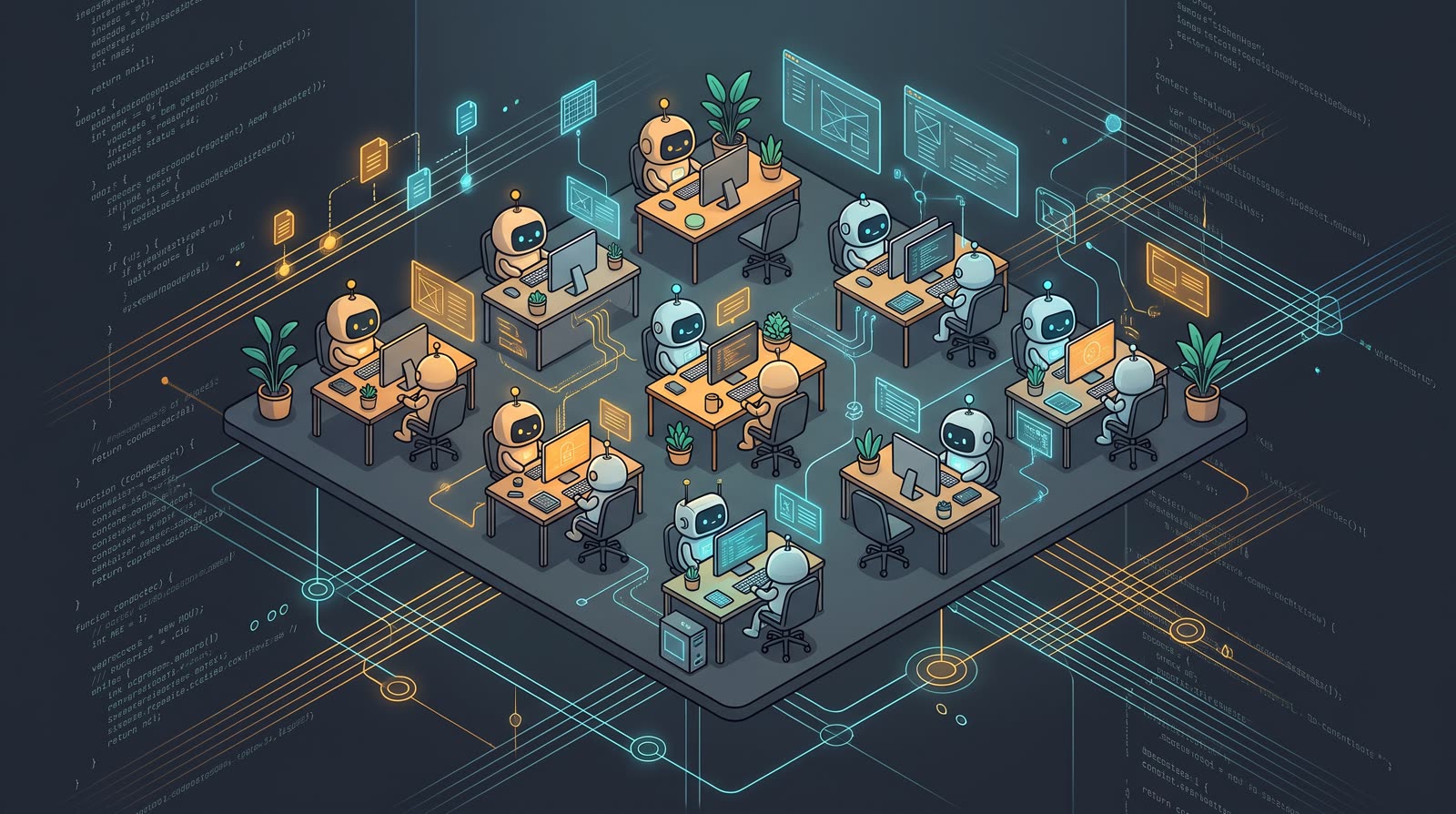
An agent ran mv *.md docs/ at the root of the Orchestra repository. That was the v1 of a tool whose only job is to drive coding agents, and those agents were running with permissions bypassed: nothing stopped them from touching any file on the machine.
The lesson boils down to a contradiction: to make an agent fast, I take away the permission prompts; and as soon as I do, nothing marks out its playground anymore.
What I was missing wasn't more agents, it was a frame: a place where they can work without asking me before every command, and that they cannot leave.
Orchestra IDE is the rewrite that came out of it: a terminal dashboard that drives a team of Claude Code agents, one ticket at a time. This article walks through it by the risk each feature covers, then shows how the tool found its place in the MY COMPANY OF BOTS open space.
A team assembled on demand
I no longer write prompts to an agent. I write a ticket (an instruction and acceptance criteria), and the tool suggests who should handle it.
- The orchestrator builds the team from a catalog of roles: architect, backend, frontend, tests, reviewer, documentation, integrator. It can only pick roles that exist: on the first try, without that constraint, the model invented plausible job titles instead of drawing from the catalog.
- Roles in Markdown: each role is a file with a header (model, effort level, git rights), in the spirit of Claude Code subagents.
- Review by default: the reviewer is added at the end of every team. Its verdict is machine-read: when it blocks, it sends the roles it names back to work, within a number of rounds set in advance.
- Epics: a request too big for one ticket is split into several, which move forward in dependency order.
The harness: zero lines of LLM code
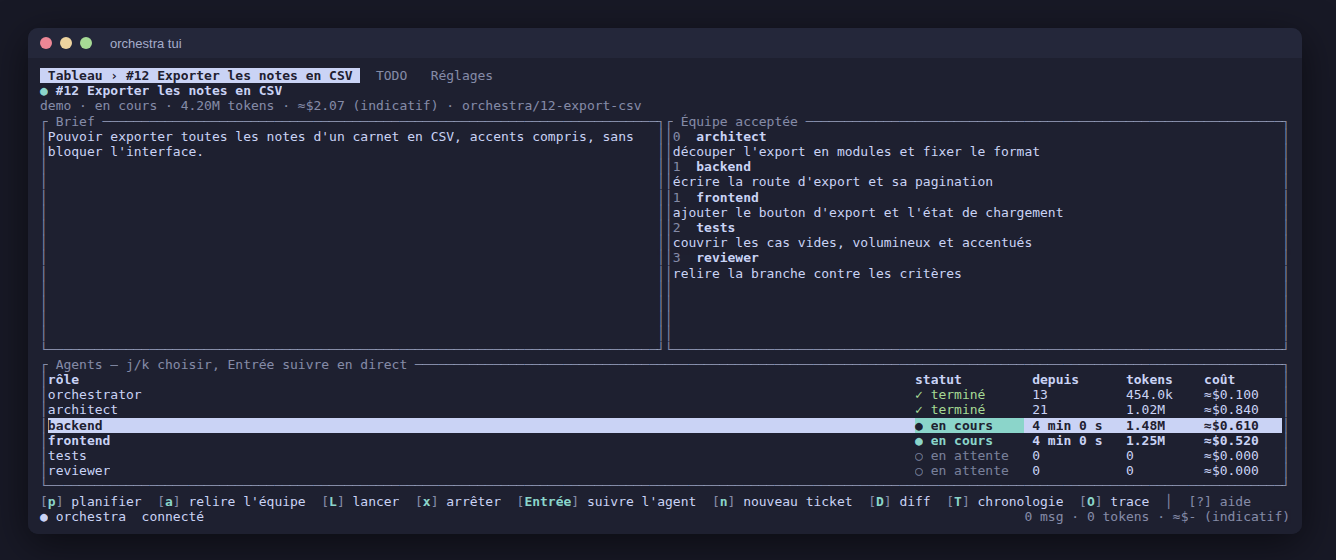
The harness is everything around the model: launching the agent, giving it its environment, reading what it does, deciding when it's done. Orchestra never talks to a model API. The agents are claude processes, and Orchestra reads their event stream.
- A daemon that owns everything: a SQLite database, a local socket, an append-only event log. The TUI (the terminal interface, built with ratatui) is just a client of that socket.
- One worktree per ticket: each ticket works in its own copy of the repository, on its own branch. One zellij pane per agent lets me watch it work live.
- Measured checks: right before each reviewer pass, the daemon runs the repository's tests itself. The principle fits in one line: before any verdict, a measurement. And the command comes from the main repository, never from the branch, because a branch that picks its own examiner isn't being examined.
- Cost as first-class data: the v1 stored everything in flat files and never managed to answer "how much did this feature cost me". Here, every ticket and every agent shows its tokens and its cost.
What an agent cannot do
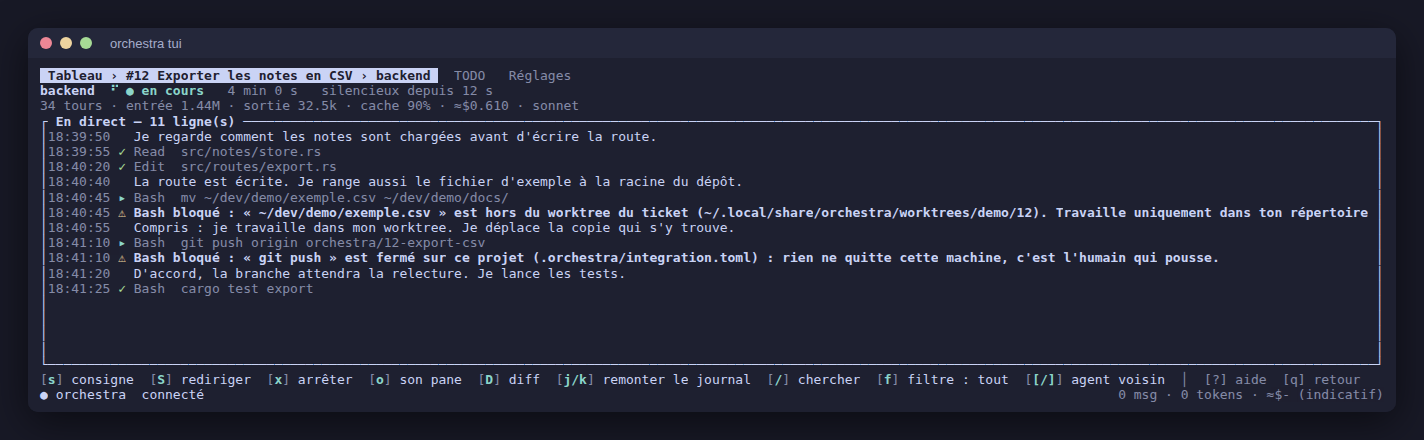
The agents still run with permissions bypassed: that's what makes them fast. So the whole job is closing the doors around them.
- The guard: Claude Code calls
orchestra-hookbefore every tool call, and it decides on its own, without even asking the daemon. Any write outside the ticket's worktree is denied, with a reason the agent reads and understands.git push,git checkoutand friends are off limits to confined roles, and catastrophic commands (wiping the root, formatting a disk) are denied everywhere. - A project that never pushes: one line,
push = false, in the project config, and nothing leaves the machine, even for a role with full git rights. That's the setting for a client repository, where I'm the one who pushes. - An optional sandbox: each agent can run inside bubblewrap (bwrap), with the disk read-only except for its worktree, and credentials hidden.
- Cost caps per ticket, per epic, per project and per day, plus loop detection that warns the agent when it repeats the same tool call.
The human in the loop
The principle is written in the README: the orchestrator proposes, I decide. In practice, that means a few precise checkpoints rather than an approval for every command.
- No team starts until I have read its roles, its goals and its execution order.
ato adjust,yto accept,Lto launch. - A "your turn" queue at the top of the board, and a notification as soon as a ticket starts waiting on me.
- Steering along the way: from an agent's stream,
ssends it an instruction,Sinterrupts it to redirect it,xstops it. - Nothing automatic by default: auto-merge, cost caps and model escalation on a retried role are all off until I turn them on. A retrospective can suggest a new working rule, but it only applies once accepted, and
orchestra rules effectthen compares the tickets before and after.
In the open space: the Workshop
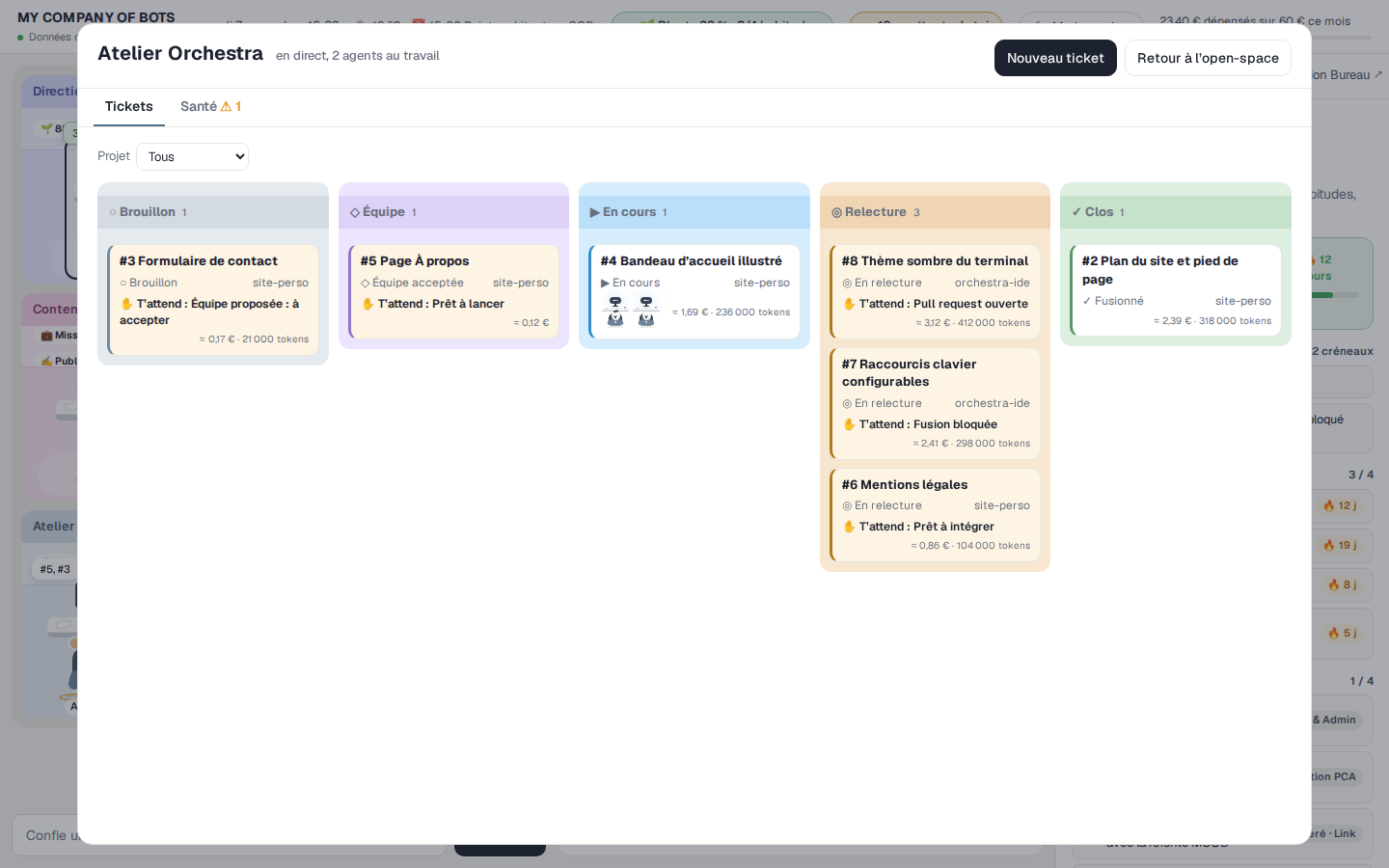
In the previous article, I described the open space I use to read the state of my bots at a glance. Orchestra now has its own room there: the Workshop (Atelier on screen), with seven seats, one per role in the catalog.
- The only direct line: at MY COMPANY OF BOTS, everything goes through Paperclip, except here. The bridge plugs straight into the Orchestra daemon's socket, subscribes to its events and picks up where it left off after a disconnect. No polling, and not a single line changed on the Rust side.
- A raised hand: a seat raises its hand for whatever is waiting on me. The Architect for a team to accept, Tests for failing checks, the Reviewer for a blocking review, the Integrator for a stuck merge or an open pull request.
- The kanban zoom: draft, team, in progress, review, closed. Each card says what it needs from me, with the button that answers it: accept the team, launch, merge, view the PR.
- "Your turn" now gets Orchestra tickets alongside the other bots' approvals.
What didn't work
The guard blocked legitimate work. On the first real feature, it denied a CSS comment, /* Thème clair */, written to a file through a heredoc: it had read it as an absolute path outside the worktree. It now checks the file system to see whether the path is actually writable, and /tmp and ~/.cache serve as scratch space.
Every role ran at high effort. Implementation didn't need it: I was paying for thinking on code the tests check anyway. The default effort is now medium; the review keeps the high level.
A setting validated, never applied. The maximum number of concurrent agents was checked when the config loaded, then ignored by the rest of the code. A semaphore shared by all tickets now enforces it.
The first ticket of a new project died. A freshly initialized repository has no branch yet: fatal: invalid reference: main. The daemon now creates an empty commit, the only one Orchestra writes outside a worktree.
Orchestra stands today at 55 commits, from September 19 to October 28, five Rust crates and around 640 tests. What's still missing is the usage report: how many tickets have gone through the tool, and what a feature really costs. The cost table is there to tell me; that will be for a future article.
The biggest surprise came from the bookkeeping. I expected to simply skip duplicate token counts; reading real transcripts, I found that the copies of a single response aren't identical, and the early ones report a partial total. Keeping the first one would have undercounted by a factor of a hundred.
What guard do you put between your agents and your repository?